dual-use acquisitions, identified from around 1,160 announced transactions.
Targets headquartered in the EU, UK, Switzerland and Norway.DUAL-USE FOUNDERS HANDBOOK / VOL. 3 / 2026
Building European Champions
Architecture of Resilience
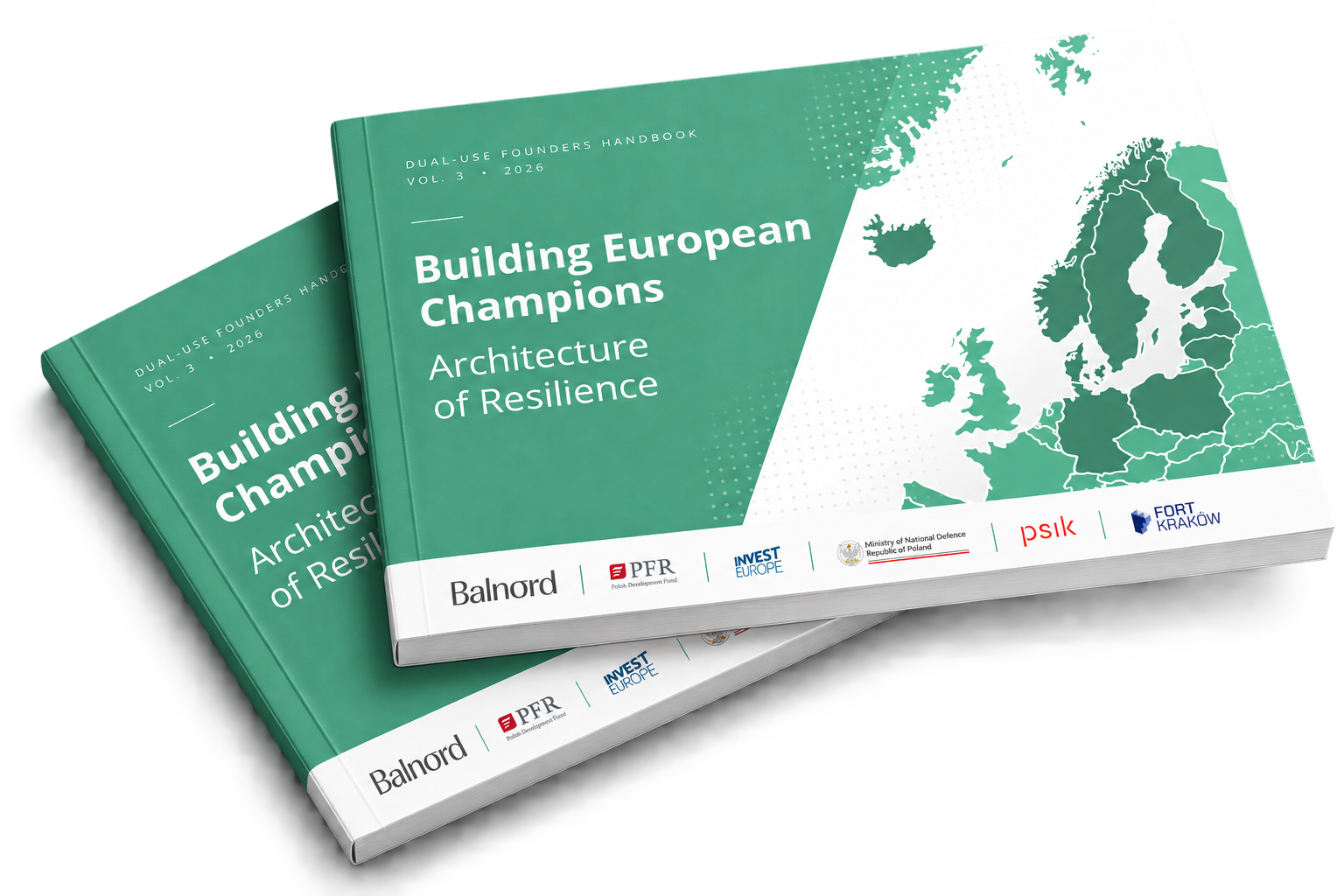
Volume 3 looks at how European dual-use startups become companies that civilian and defence customers depend on.
Written with NATO, Poland’s Ministry of National Defence, Europe’s leading financing institutions, industry, defence primes, investors and founders.
Free PDF · 2026 edition. Receive the Handbook and Frontier Tech Brief by email. Confirm your address to subscribe.
Already on our list through Vol. 1, Vol. 2 or Frontier Tech Brief? The new edition will come straight to your inbox.
Previous editions: Vol. 2 (2025) / Vol. 1 (2024)
Main partners




Why you should read this report
Winning a defence contract can mean supporting a product for years after the sale. That commitment has to be part of a startup’s business model from the beginning.
“Europe has excellent universities, scientists, engineers and founders. Increasingly, we also have venture capital willing to finance them. But a prototype is not a capability. Neither is an accelerator programme, a successful experiment or, in many cases, even a first defence contract.”

Marcin P. KowalikManaging Partner, BalnordDual-Use Founders Handbook Vol. 3, p. 94
Balnord’s acquisition research
of hardware, space, sensing and autonomy acquisitions went to defence primes and mid-tier groups.
This sector sample is a subset of the 85 acquisitions.of the same sector sample went to industrial groups entering defence: an engine maker, a connector company, a fire-truck manufacturer.
selected confirmed EBITDA multiples. Margins and growth influence pricing.
DeltaNordic: 9.65x (2026E). Smiths Interconnect: 15.1x (FY2025). These are selected deals, not the full range.Announced September 2025–September 2026. Source: Volume 3, pp. 66–67.
Primes are buying delivery capacity. Defence scale-ups are buying their way into new domains, often through companies built for civilian work.
What you’ll find inside
NATO DIANA explains the procurement routes open to startups. Microamp describes its UK contract through the Rapid Adoption Service, and Poland’s Ministry of National Defence discusses what can follow a successful test.
Company account: Infinite Orbits describes setting up a PALADIN framework in under three months, with a ceiling of up to €50m. The timescale is specific to this case.
Start with pp. 26–27, 53–54 and 63–65.
The EIB Group maps the financing available at each stage of growth. Its Cailabs case follows the company’s use of publicly backed equity and venture debt, including investment in optical ground station production.
Start with pp. 28–31. See the financing map on p. 29.
Raytheon explains what it takes to qualify as a supplier, including investment a company may need to make before it has a contract. Its parent, RTX, works with more than 13,500 European suppliers.
Patria describes how eALLIANCE brings more than 70 organisations into joint development.
Start with Raytheon on pp. 55–57 and Patria on pp. 58–59.
Aleksander Dobrzyniecki looks at growth beyond the first market. Infinite Orbits’ Adel Haddoud describes expanding across Europe, with a new factory and acquisitions.
Paweł Pacek’s analysis of the NATO Northern Corridor focuses on recruitment. It explains how skills shortages and security clearance constrain the companies hiring there.
Start with p. 41 and pp. 50–54.
Balnord examines 85 announced dual-use acquisitions from September 2025 to September 2026. The study finds established primes buying delivery capacity, while defence scale-ups use acquisitions to enter other markets.
The tables record disclosed prices and deal structures, with notes on the gaps in the available data.
Start with pp. 66–69.
Chapter IV asks the people who define military demand what they need, domain by domain.
Land: Brig Gen (Res.) Adam Duda, Polish Dual-Use Chamber, on speed, supply chains and a once-in-a-generation window. p. 74
Maritime: Admiral Pierre Vandier, NATO’s Supreme Allied Commander Transformation, on lessons from the Baltic and Task Force X. p. 78
Air: Ragnar Sass, Darkstar, on the race against jet-powered drones flying at up to 600 km/h. p. 80
Cyber: Izabela Albrycht, AGH University of Kraków, on cyber capabilities in military operations, and Dr Joanna Świątkowska, ECSO, on Europe’s cybersecurity investment gap. pp. 83–87
Space: Lt Gen (Ret.) Philippe Adam on a European dual-use space architecture, and Laurynas Mačiulis, Astrolight, on why a satellite is only as sovereign as its link. pp. 88–91
Start with Chapter IV, pp. 69–91.
Read selected contributions
Six contributions from Volume 3. Read an excerpt before downloading the full Handbook.
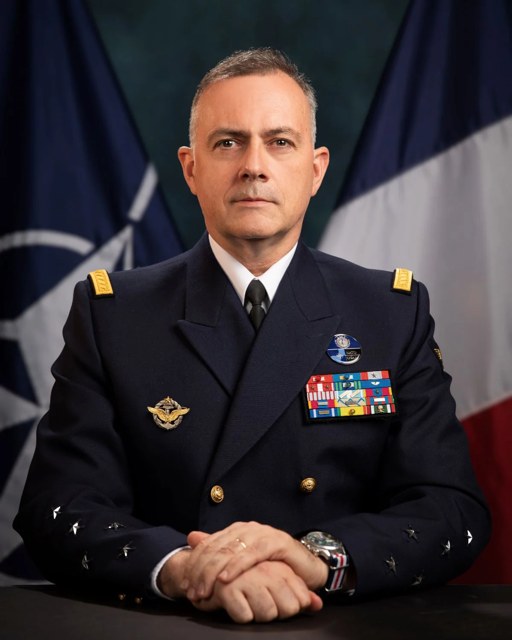
Admiral Pierre VandierSupreme Allied Commander TransformationNATO
What NATO needs at sea
Lessons from Task Force X-Baltic on turning commercial maritime technology into capabilities nations can use.
“Ultimately, the test is straightforward: does an experiment lead to capabilities that nations will fund, field and sustain—and that can operate together?”
Read an excerptClose excerpt
Maritime Dual-Use Demand: Lessons from the Baltic
Dual-Use Founders Handbook Vol. 3, pp. 78–79. Excerpt: p. 79.
Demand signals are plural because they serve different purposes. An operational priority identifies the effect required. A research challenge opens a problem to exploration; a standard shapes design; a programme creates a purchasing opportunity; and an industry proposal shows what technology or supply is available. The strongest signals connect a defined mission with identifiable users, technical evidence, resources and a credible path towards procurement. An invitation to experiment may be enough for a company to participate and learn, but it does not support the same investment decision as a funded requirement. That does not mean every useful signal must already amount to a procurement commitment.
Task Force X illustrates how this can work in practice. Experimentation in the Baltic moved beyond demonstration towards nationally owned capabilities, with Germany moving first in the transition to Phase II. Italy later took direct leadership of Task Force X-Central Mediterranean, the first iteration led by an Allied nation. Task Force X-Arctic is applying the model to persistent, data-centric awareness across the North Atlantic and High North. Each region provides evidence and operational experience that nations can use to shape their own capability choices.
Nations buy most operational assets. NATO also creates demand through common-funded programmes and interoperability requirements, but it is not a single buyer for every Allied need. Its distinct contribution is to reduce uncertainty for nations and industry. Experimentation, scientific expertise, operational access and multinational testing can show whether a technology works in realistic conditions and how it fits within a coherent capability architecture.
Get the full Handbook ↑
Dr Ari JónssonPresidentNATO Innovation Fund
Where financing still falls short
Why growing venture investment still leaves gaps on the path to deployment, and where government contracts can help.
“A signed Ministry of Defence contract is proof of product-market fit that no pitch deck can replicate.”
Read an excerptClose excerpt
Financing the Dual-Use Startups: Where Capital Flows – and Where it Still Doesn’t
Dual-Use Founders Handbook Vol. 3, pp. 24–25. Excerpt: p. 25.
Companies like ARX, STARK, Tekever, and TYTAN are already deployed in Ukraine. Quantum Systems reached €300 million in revenue at 173% growth. ICEYE, €250 million. These are not outliers – they are the model. The problem is the gap between political intent and procurement reality. Pathways for startups to access government contracts remain slow and opaque. Procurement cycles were designed around established primes with decades of compliance infrastructure – not around a founder generating €300 million in revenue after five years of operations. Entry points are unclear, tender requirements are often disproportionate to contract size, and payment terms can stretch long enough to create serious working capital risk for fast-growing businesses.
Ministries of Defence across the Alliance have committed publicly to bringing innovative companies into their supply chains. The barrier is often process. Shorter cycles, clearer entry criteria, governments derisking the investment for VCs by offering smaller contracts with the option to increase over time would help unlock this engine of financing. The Rapid Adoption Action Plan, launched at the 2025 NATO Summit, points in the right direction. The proof will be in whether procurement offices actually change how they operate.
Get the full Handbook ↑
Eric de MontgolfierCEOInvest Europe
Financing European champions
What happens after a startup succeeds, and why Europe’s financing system must support the company it becomes.
“Europe cannot build champions if capital can enter companies but cannot efficiently exit them.”
Read an excerptClose excerpt
From Innovation to Capability: Financing Europe’s Dual-Use Champions
Dual-Use Founders Handbook Vol. 3, pp. 19–21. Excerpt: pp. 20–21.
For dual-use companies, the exit question is more complex than a simple choice between an IPO and an acquisition. Security reviews, export controls, classified programmes, government-customer concentration and restrictions on the transfer of sensitive capabilities can all affect who may buy a company, on what timetable and at what valuation.
However, IPOs remain historically subdued 5. That makes acquisitions, including cross-border ones, a crucial route to scale and liquidity. A successful exit is not the end of the story. It returns capital to investors, rewards founders and employees, and enables fund managers to raise and invest again.
Cross-border activity is already fundamental to European private capital. In 2024, it represented 32.3% of investment within Europe 6. Yet strategic companies and their investors face expanding scrutiny around ownership, acquisitions, subsidies and consolidation. Each measure may pursue a legitimate objective. Taken together, if poorly calibrated, they can narrow the pool of investors and buyers precisely when Europe needs its companies to scale.
Europe must protect genuinely sensitive technologies and capabilities. But resilience should not come at the expense of an open and functioning European investment market. Strengthening Europe’s own capital base and attracting responsible international investment are not contradictory objectives. Europe needs both. International investors bring funding, specialist expertise, commercial networks and access to global markets. Proportionate safeguards can protect strategic interests without isolating the companies expected to compete on Europe’s behalf.
Get the full Handbook ↑
Douglas StevensonVice President, Europe and NATO, Requirements and CapabilitiesRaytheon, an RTX business

David TaubmanSenior Director, Global Industrialization, Europe and the AmericasRaytheon, an RTX business
Working with Raytheon
How a supplier relationship develops, including the work a smaller company must finance before a contract arrives.
Read an excerptClose excerpt
Working with Global Defense Primes in Europe: A Raytheon Case Study
Dual-Use Founders Handbook Vol. 3, pp. 55–57. Excerpt: p. 57.
For smaller businesses, entering the defense segment can require an initial investment of time, resources and capabilities, often well before the commercial benefits materialize. This reflects the high standards required to support government customers, including expectations around security, quality and compliance. At the same time, becoming qualified and established within a program can create opportunities for long-term collaboration. Suppliers may go on to support a program for many years, potentially serving customers in the United States and across allied markets. The experience and qualifications gained through this process can also strengthen a company’s credentials and open doors to other opportunities in the broader defense segment, including with prospective customers and investors.
New relationships can stall even when there is sufficient mutual interest.
The parties must therefore treat the relationship as a long courtship rather than a single transaction.
The outside company must be able to demonstrate their commitment by continuing to show up, a willingness to support dramatic swings in customer decision making and delays, and a capability of self–funding what can potentially be an extended pre–contract phase.
Get the full Handbook ↑
Meg AdamsSystems Engineering Division DirectorThe MITRE Corporation

Scott LeeChief Engineer, Army C4ISRThe MITRE Corporation
From technology to military capability
How mission engineering helps companies understand where their technology fits within a military system.
Read an excerptClose excerpt
From Innovation to Capability at Mission Speed
Dual-Use Founders Handbook Vol. 3, pp. 42–43. Excerpt: p. 42.
Europe does not face an innovation gap; it faces a speed-to-capability gap. Across Europe and the global commercial market, artificial intelligence (AI), autonomy, space, communications, sensing, software, and data technologies are advancing faster than traditional defence acquisition systems can adapt and field them. The strategic challenge is not simply to develop better technology, but to translate innovation into interoperable, scalable military capability at the speed demanded by the operational environment.
Doing so requires more than purchasing commercial technologies or accelerating acquisition pathways. European nations must design their forces to rapidly integrate technologies from different companies, countries, and sectors, and to evaluate, adapt, replace, and combine those technologies as operational needs change. The goal is not simply faster technology adoption, but forces that can continuously integrate innovation to deliver military capability.
Mission Engineering, enabled by Digital Engineering, provides a way to do that. Mission Engineering starts with the military outcome rather than a particular platform or technology. It examines the complete mission system, including sensors, command and control (C2), data, networks, effectors, logistics, people, and decisions, that must work together to generate an operational effect. Mission Engineering can help identify and develop the dual-use potential of current and emerging technologies. By understanding the mission context, companies can determine what operational effect their technology could enable, where it fits within the broader mission system, what capabilities and interfaces it must work with, and what adaptations may be necessary to translate commercial innovation into operational capability.
Get the full Handbook ↑
Andrew A. MichtaProfessor of Strategic StudiesUniversity of Florida
Europe’s eastern frontier
Why Europe’s changed security environment requires a stronger defence-industrial base.
Read an excerptClose excerpt
Strategic Implications of the Changed Security Environment on NATO’s Eastern Frontier
Dual-Use Founders Handbook Vol. 3, pp. 6–8. Excerpt: p. 8.
For countries on NATO’s eastern flank, this underscores an urgent need to mobilize resources to build and exercise real military capabilities. In particular, countries in the Northeast Corridor need to work closely to establish regionally integrated and exercised structures under NATO’s umbrella. The March 2023 agreement signed at Ramstein by Denmark, Finland, Norway, and Sweden offers a potential model for deeper military integration within NATO. Under the agreement, the four countries committed to developing a joint Nordic air operations concept encompassing integrated command and control, coordinated operational planning, flexible basing, shared air situational awareness, and joint training and exercises. The objective was to enable their approximately 250 combat aircraft to operate seamlessly as a single, coordinated force while retaining national command authority. Other NATO allies should pursue similar initiatives, especially in the Northeast Corridor.
If the balance of power in Europe is to hold, the allies need to pursue new, creative solutions, drawing on battlefield lessons from Ukraine, accelerating the introduction of dual-use technology, and shifting the philosophy of weapons procurement to replace the current scarcity of uniquely capable platforms that can be purchased in only limited numbers with inexpensive, mass-produced alternatives that can be deployed and, if need be, attrited at an acceptable cost. This must include leveraging the West’s private capital markets to expand production capacity and shorten weapons delivery cycles. NATO’s funda - mental challenge is to restore deterrence, which was woefully neglected over the past three decades, and to ensure that an all-out conflict with Russia does not occur. This is a formidable task, but Europe has the requisite economic and population resources to accomplish it. The challenge is to match these resources with the political leadership and will to confront the nature of the threat facing the alliance head-on.
Get the full Handbook ↑A closer look inside
Two excerpts from Volume 3. Open a sample page to read it in full.
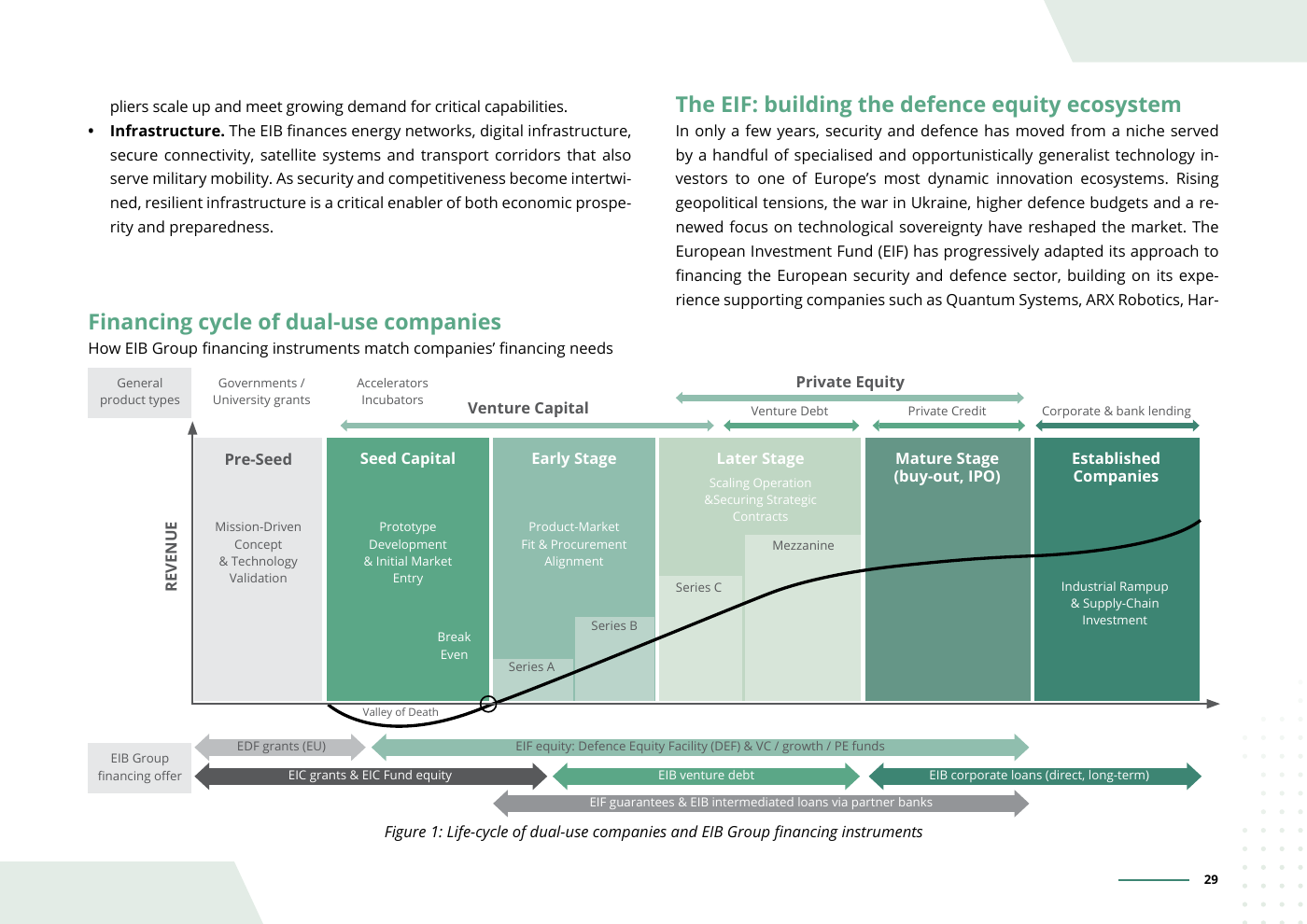
Which capital fits your next stage?
The EIB Group’s financing map shows which types of capital are available as a company grows. Page 29.
View sample page 29 ↗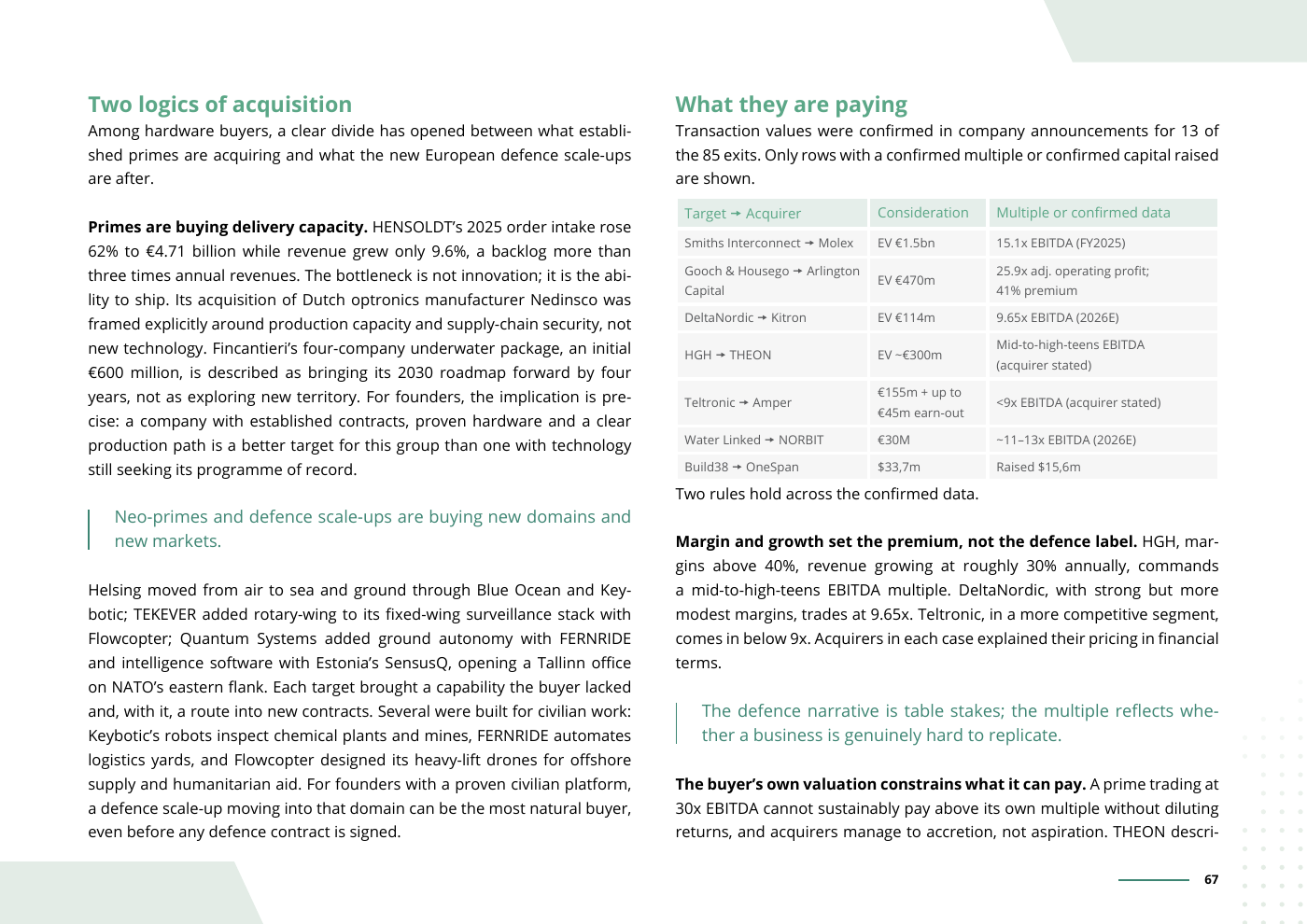
What are buyers actually paying?
Disclosed acquisition prices from Balnord’s research, with confirmed multiples where available. Page 67.
View sample page 67 ↗VOLUME 3
Authors and contributors
Marcin P. KowalikManaging PartnerBalnord Wojciech DrewczyńskiHead of ResearchBalnordAndrew A. MichtaProfessor of Strategic StudiesUniversity of Florida
 Mikołaj RaczyńskiPresident of the Management BoardPolish Development Fund (PFR)
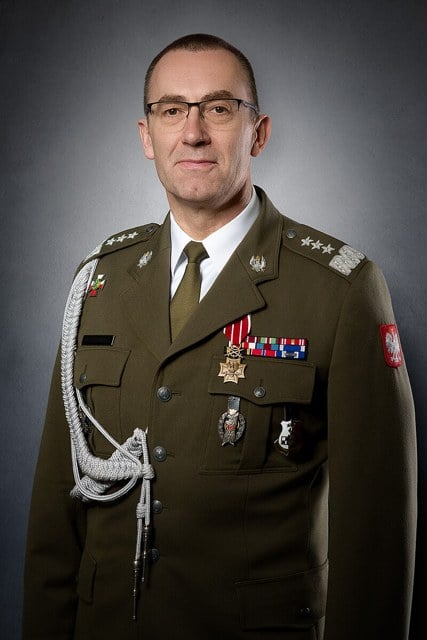 Lt. Gen. Tomasz
Piotrowskiformer Operational CommanderPolish Armed Forces
(2018-2023)
 Lt Col (Ret.) Dakota L. WoodOwner and CEOHot Gates Consulting
 Jack WangPartner and Managing DirectorProject AEric de MontgolfierCEOInvest Europe
 Prof Dr Paul TimmersProfessorKU Leuven / European University CyprusDr Ari JónssonPresidentNATO Innovation Fund
 Ryan BenitezChief Commercial OfficerNATO DIANA
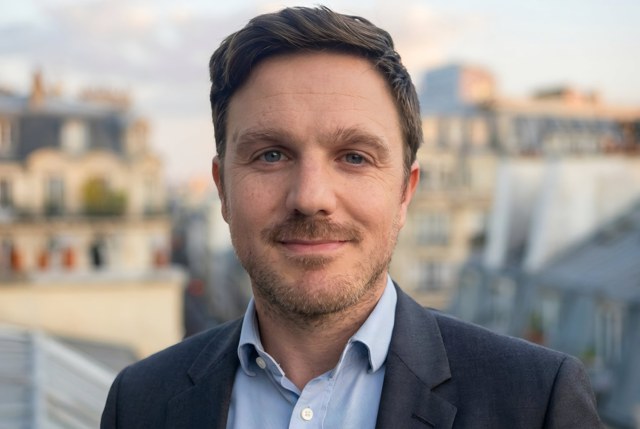 Pierre LimouzinSenior Investment Officer, EIB/EIC Fund TeamEuropean Investment Bank
 Alejandro Raboso CamposSenior Officer, Security and Defence OfficeEuropean Investment Bank
 Nabil Ben MahdiSenior Officer, Mandate Design and Product DevelopmentEuropean Investment Fund
 Wojciech DzięgielMember of the BoardCasimir Pulaski Foundation
 Bartosz JózefowskiHead of FORT KrakówKrakow Technology Park
 Anna WnukManaging DirectorPolish Private Equity and Venture Capital Association (PSIK)
 Aleksander MokrzyckiDeputy CEOPFR Ventures
 Aleksander DobrzynieckiGeneral PartnerBalnordMeg AdamsSystems Engineering Division DirectorThe MITRE CorporationScott LeeChief Engineer, Army C4ISRThe MITRE Corporation
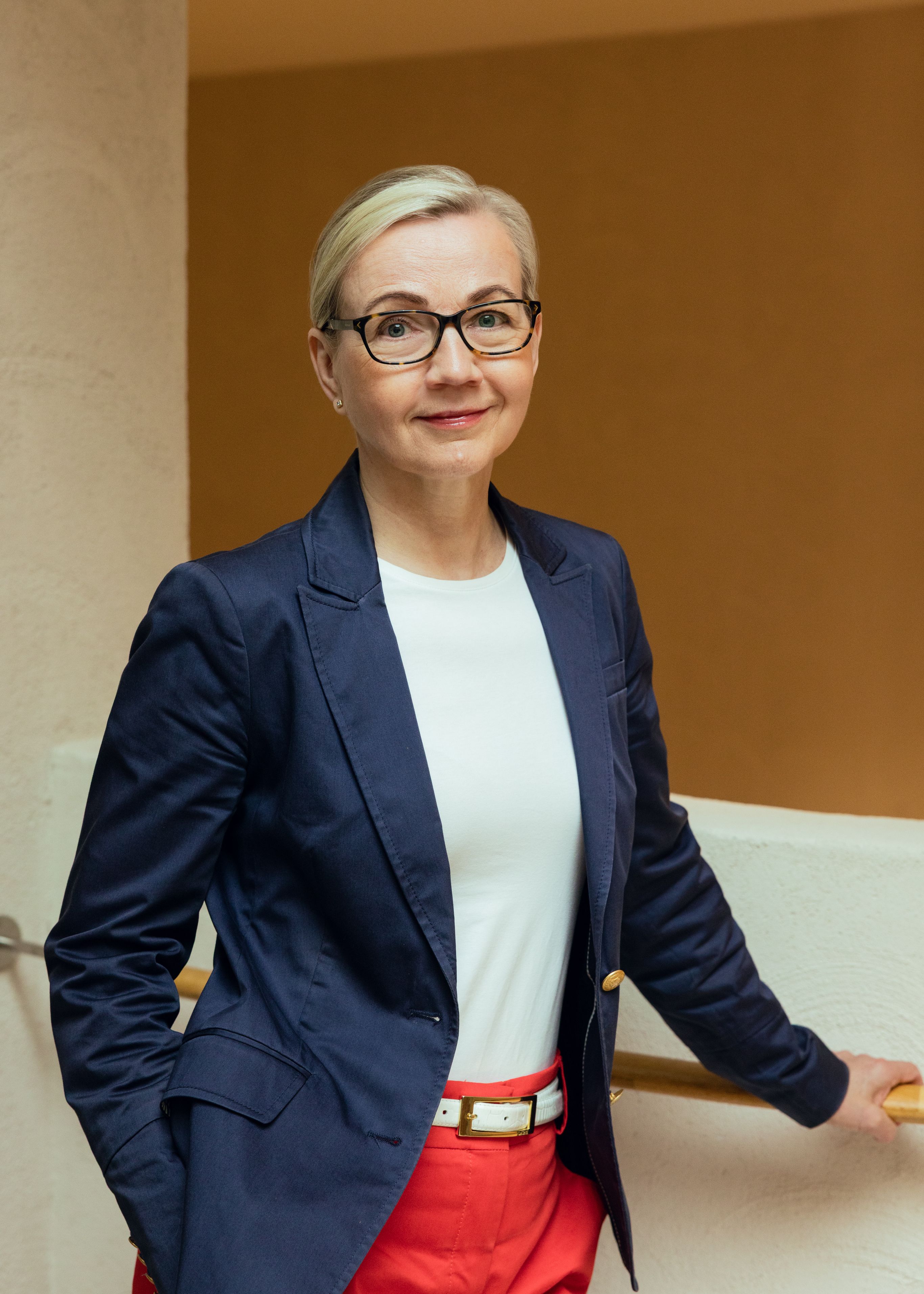 Tiina Laisi-PuheloinenCEOFinnish Business Angels Network (FiBAN)
 Dr Raluca CsernatoniFellowCarnegie Europe
 Paweł PacekBoard MemberSpace Entrepreneurship Institute (Poland)
 Adel HaddoudCEOInfinite OrbitsDouglas StevensonVice President, Europe and NATO, Requirements and CapabilitiesRaytheon, an RTX businessDavid TaubmanSenior Director, Global Industrialization, Europe and the AmericasRaytheon, an RTX business
 Juha VälimäkieALLIANCE Programme LeadPatria
 Paweł HurasDirector of the Innovation Development DepartmentPolish Development Fund (PFR)
 Weronika MystekDual-Use Ecosystem Development ExpertPolish Development Fund (PFR)
 Brig Gen Marcin GórkaDirector, Department of InnovationMinistry of National Defence, Republic of Poland
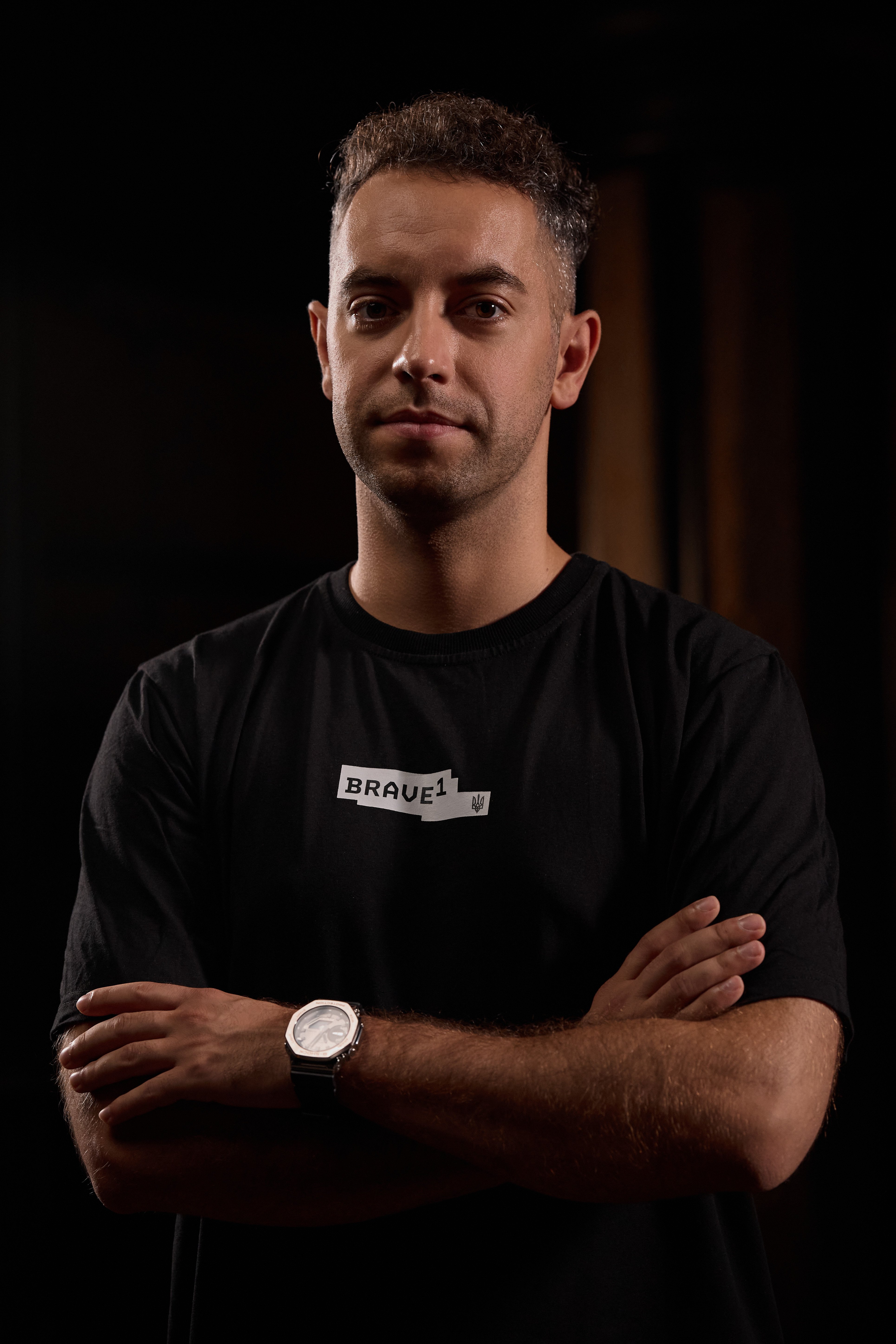 Artem MorozHead of Investor RelationsBrave1
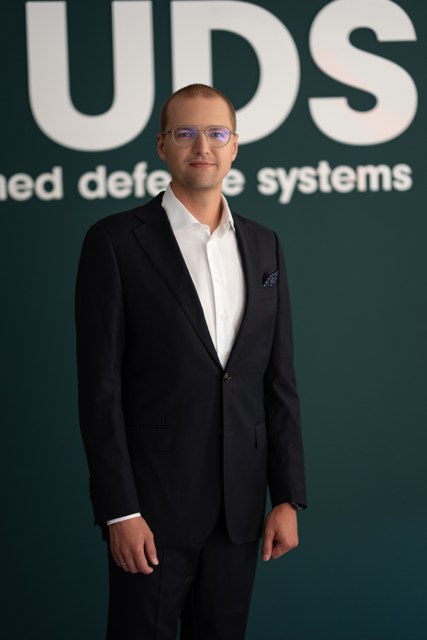 Žilvinas KvedaravičiusCo-Founder and Chief Commercial OfficerUnmanned Defense Systems
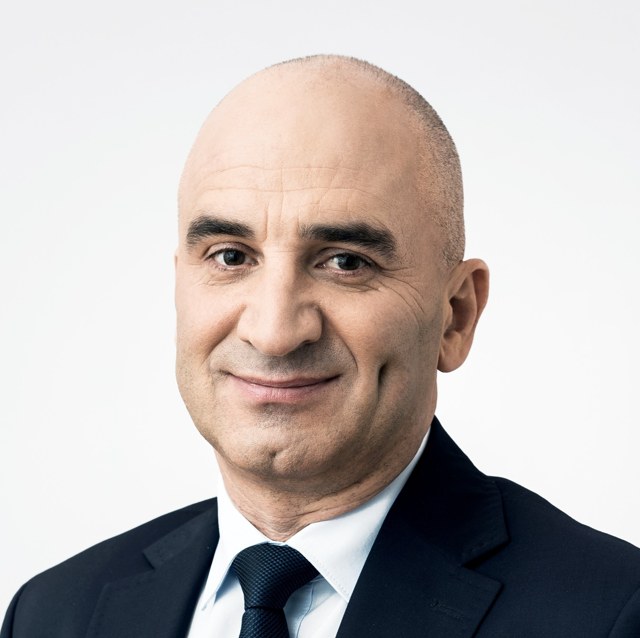 Brig Gen (Res.) Adam Duda, PhDPresidentPolish Dual-Use Chamber (PIDU)Admiral Pierre VandierSupreme Allied Commander TransformationNATO
 Ragnar SassCo-FounderDarkstar
 Dr-Ing. Felix WellmannCTO and Managing DirectorINLEAP Photonics
 Dr-Ing. Marius LammersCEOINLEAP Photonics
 Izabela AlbrychtDirector, Cybersecurity Centre; FORT Kraków LeadAGH University of Kraków
 Dr Joanna ŚwiątkowskaSecretary GeneralEuropean Cybersecurity Organisation (ECSO)
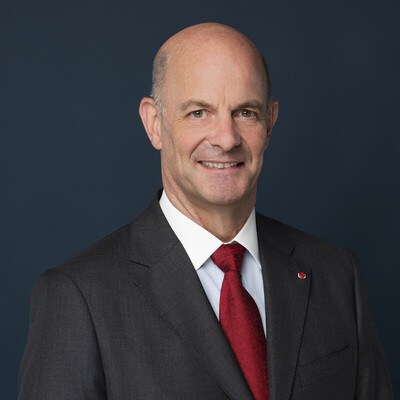 Lt Gen (Ret.) Philippe AdamFormer Space CommanderPhAS Conseil
 Laurynas MačiulisCo-Founder and CEOAstrolight
 Małgorzata ChmielewskaDIANA Accelerator ManagerFORT Kraków
Contributing organisations





















About Balnord
Balnord is an early-stage investor in frontier technology and dual-use companies, with a focus on the Baltic Sea region. We publish the Handbook so founders can learn about the defence market from people already working in it.
Balnord SARL
28, boulevard d’Avranches
L-1160 Luxembourg